You must log in or # to comment.
My bowl of rice comes from one prefecture over. I’d buy more locally if I could, but I prefer brown rice to white and they locally polish basically everything.
Maybe, if you’re only talking about individual people, but the big polluters are corporations, not people. That’s where the focus should be.
Stopping overproduction is what we should focus on.
Only if you ignore all the stuff people consume. If a corporation pollutes and you buy their stuff, you’re on the hook for that pollution. We all are. We should be buying stuff that doesn’t pollute, and finding ways to save energy, water, and packaging.
Ok, that’s an excellent sentiment, but utterly worthless in the real world. People will buy what is available and what is cheap. A handful of people choosing to be conscious with what they purchase is a drop in the bucket compared to what the masses will do.
I get it. Convincing the people to not buy stuff that pollutes should be the easy route, but it’s not. And unfortunately we don’t live in the world of “it should be this way”, we live in reality. And in reality, the only real way to stop pollution heavy products from being sold is to go after the companies making them directly. Boycotts alone will not work because, again, as long as the products are available and cheap, people will buy them; morals be damned.
Not always. I’ve always tried to buy what is better for the planet, even if that costs a bit more. Or will repair stuff instead of toss and buy.
There are dozens of us 😀
Unfortunately, convincing corporations to not pollute isn’t any easier. Using the tools of government to regulate them even harder still. It all comes down to people and what they want. Try to circumvent them and they’ll fight back.
Just look at what’s happening right now. Trump is rolling back tons of environmental and agricultural (anti- animal cruelty) regulations all the time. What activists had counted as previous wins are now going away.
Oh bullshit. Governance can absolutely compel industry to reform.
And political movements can undo government reforms, as we’re seeing right now.
Government reforms are still more effective than anything else we’ve tried. By focusing on individual reform, you’re playing right into the hands of the 1%. There’s even a book about it!
You can’t enact government reforms without winning an election, and to do that you need to convince individual voters. But then if you enact your reforms without a strong mandate, those reforms will be gone next election.
Anyway, that book is about nudge theory which is NOT what I’m arguing for. I already knew that bit of pop psychology was BS years ago.
Yeah, copy the bug corporate agenda: blame the consumers. Shift the blame onto them, so you won’t be held accountable for producing most pollution. Consumer pollution is just a tiny fraction compared to corporate and government pollution.
I don’t give a shit about assigning blame. There’s too much of that crap around here. It’s completely unproductive.
This but unironically.
Every environmental activist out there who spends their afternoons shaming people online for going about their most mundane, domestic activities (“how dare you use a hot cycle for your single load of laundry!?”) are actively complicit in enabling and normalizing billionaires’ continued ravaging of the earth’s resources. It keeps everyone distracted from the actual problem and trapped in an “us vs them” mentality where the public can never collectively unite to turn the heat around on those in power.
I’m not cutting my decompression-after-surviving-another-day-in-dystopia shower short while Musk installs another infinity pool in his Arizona summer home lol, so stop asking.
Ever since data centers have begun consuming staggering amounts of water and electricity while providing unprecedented amounts of pollution/toxic waste/noise/more, I’ve really given up feeling responsibility for making the world better/cleaner. I’m not going to change my behaviors–I’ll still recycle and be careful about energy/water consumption, but the advent of the data center threw a similar “fuck you” as when i discovered how little the recycling of plastic bottles actually makes any impact (and that we were basically sold a glaring lie + promise by major bottlers like coke and pepsi)
“We won’t be fooled again” 🥴
Plastic recycling is actually picking up as the economics make more sense.
But its still better to use/buy things in more recyclable containers…
If we can ever get rid of the capitalists, we could switch to compostable containers for most or many goods. They’ve already been invented; they’re just not seen as profitable to implement on a wide scale.
That’s what really sucks about getting an education is being exposed to all the alternatives that have been created over the decades in many fields but we’re just kinda put on the shelf because the capitalists said “but what about number go up?”
There is so much shit we could change and have everyone be better off for it yet we don’t cause it won’t make number don’t go up.
I work for a company that is one of the top worldwide plastic polluters. We use plastic in packaging. I was in an astonishing series of meetings recently, organized by the global corporate office for legal, R&D and supply chain that went like this:
First, we had a series of trainings about climate change that had none of the typical bullshit. They straight explained that the whole idea of recycling is stupid and shifts focus to the part where it makes the least impact, that carbon offsets don’t really work, that we can’t rely oil running out because the environment and the economy will collapse way sooner than that will happen.
The second part was I guess appealing to people’s emotions by showing devastating effects that humans have caused already, for example there was a picture of starved baby bird that died because the parents were feeding it plastic garbage from the ocean.
The third part was practical plans to make various industries sustainable, the point was that drastic measures are required for most companies and that the worst offenders are not consumer-facing so relying on public pressure will not work.
The fourth part was about practical challenges that are not solved yet in our company and everyone got a list of goals they should achieve by 2030. Removing the plastic entirely was one of the goals.
They actually talked about the number go up problem and how we should lobby for extremely strict sustainability legislation. I’m now personally responsible for implementation of glass or aluminum packaging that should be returned and reused. I even became a bit optimistic about the future, because typically I imagine my kids (if I had any) in 30 years living in a fascist state and their job is manning the machine guns against waves of migrants from Africa where the environment collapsed and crops failed.
Remember, the ‘carbon footprint’ metric was invented by British Petroleum’s PR team.
And while you’re at it, remember that BP was formerly named the Anglo Persian Oil Company, which held a commercial monopoly on the oil extraction of Iran. It was majority owned by the british government and served to funnel the oil wealth back to London. When Iran’s then democratically elected government wanted to nationalize the company, the UK and US fomented a coup in 1953 and installed a constitutional monarchy with a dictator Shah that would ally with the west. That’s why they have F-4 tomcats, and fun fact, he was the one who commissioned mercedes to create the G-Wagon. Eventually resentment against the government would lead to the Iranian revolution in 1979 and the hostage crisis which would create the conditions that lead to today.
Would help if we could all have a sort of environmental living kit with very low footprint. Like, you live your green life and don’t ever even think about it.
I feel like this particular post has got to be capitalist propaganda
Edit: I meant the one from the Straits Times
I wouldn’t call it capitalist propaganda to state the fact that, for example, the top 10% of wealth holders are responsible for TWO THIRDS of global warming caused by carbon emissions, with just the top 1% being responsible for 23%.
If anything, that could be called anti-capitalist propaganda, because it actively targets the wealthiest parasitic class in our society and demonstrates that their excessive consumption, funded by the wealth they extract from people’s labor, is responsible for most of our emissions.
Individuals can do things to lessen the impacts their consumption creates on the planet, but it doesn’t change the fact that the biggest current source of emissions is the wealthy.
I could buy eco-friendly soap, compostable toothbrush heads, thrift all my clothes, only buy more expensive but advertised-as-repairable devices, carefully cut around small grease stains on cardboard boxes to ensure it’s recyclable, and refuse to ever buy a drink at the store and only use a water bottle instead.
Those are all examples of actions that almost certainly would help the climate and environment more than if I wasn’t doing them… but if I’m coming back home from a long day at work for a company that sends all its profits to a billionaire who just took a private jet flight to and from lunch on some tropical island somewhere, and I just want to not feel like shit that night, is the most effective strategy really to shame me if I take a warm shower and eat some ice cream out of a non-compostable tub, or is it to concentrate everyone’s shame and collective actions onto that billionaire?
Ever since I learned about super trawlers three times the size of the Eiffel tower, I’ve been really doomerist about my own environmental impact. The fuck am I supposed to do for the environment when we have these sins against nature just floating around in the ocean? I already don’t eat fish. If I quit using plastic straws, I could cut out 100 grams of waste every year, and the environment wouldn’t even notice
I mean sure, but also why add to the issue. The more people on board with quiting plastic use the more companies have to adapt to better solutions, and can help bring awareness. But politicians in kahootz with big corp makes real change almost impossible
Because it makes my life easier, and doesn’t meaningfully contribute to the problem. Plastic use on this side of the grocery store does nothing to influence its use on the back end. It’s a lot easier to convince the public not to fight for regulations when you make them think that they’re making a difference by not using disposable straws and plastic grocery bags.
Eating two pounds of bacon fried beef on an asbestos bun is gonna kill you but there’s no point putting it down if you’re holding the elephants foot in your other hand put the one down or the other cannot kill you fast enough to matter.
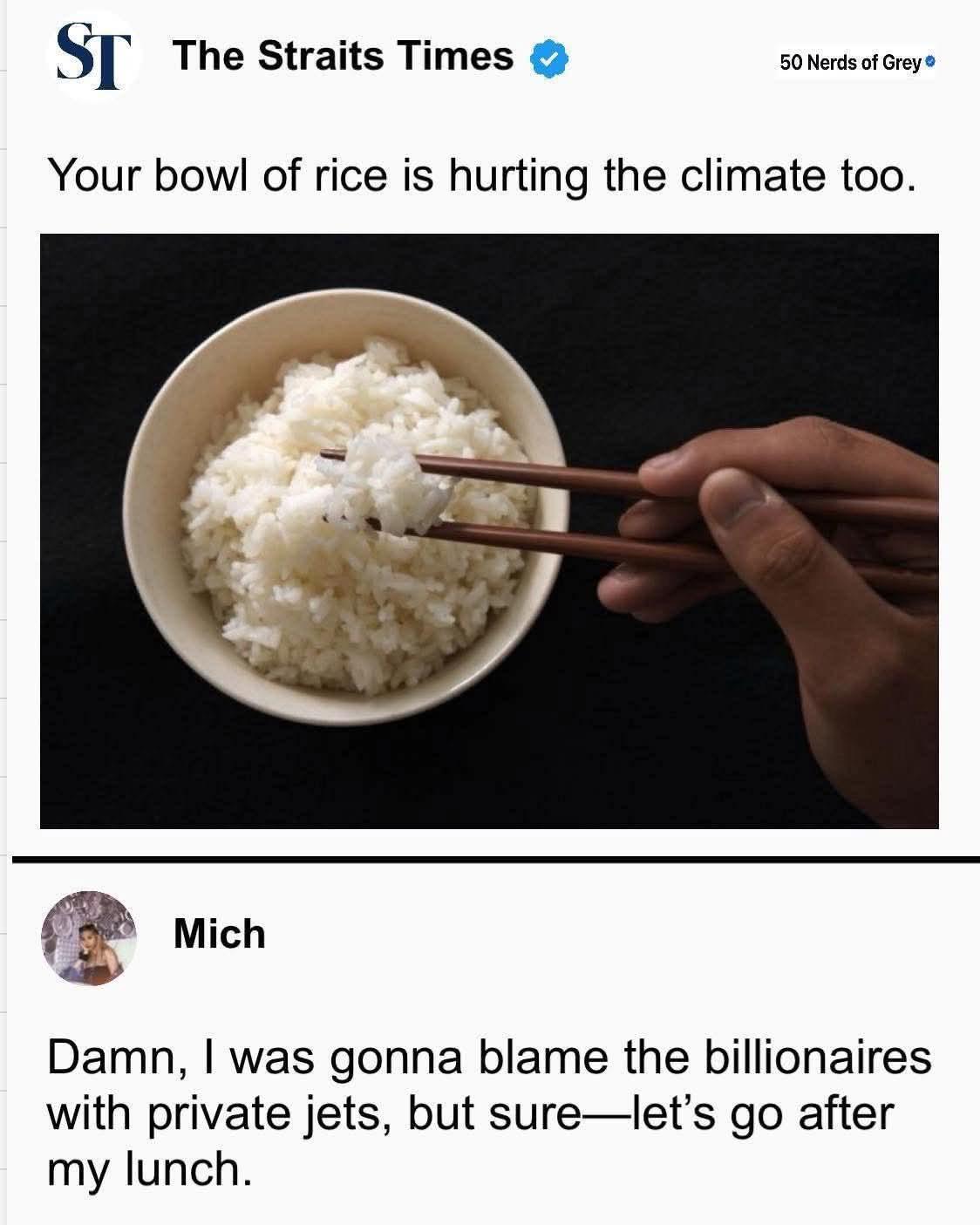
To anyone wondering, no, rice is not hurting the climate. Unlike many water-intense crops, people are not trying to grow rice in the middle of the American desert.
…unless there’s a profit to be made. Hype rice into the next superfood and watch people grow it in the desert.
ricemaxxing
5/7
If Americans ever embrace rice I’ll eat 4 pairs of vintage high top Doc Martens
What until you hear what they used slaves to vote in South Carolina.
Murican’s eat a lot of rice, and beans, at least in the southwest
Maybe it’s a regional thing… in my area the supermarkets put rice in the “ethnic” aisle 🤦
US produces something like 7 million tonnes of rice every year, mostly for internal consumption. It’s not anywhere near China or India, but the US does already eat a shitload of rice.
But for people of Asian heritage. It’s not like European americans eat considerable amounts of rice.
I already said it earlier, but Rice was a major crop in the pre civil war south. There is even a varietal names after the Carolinas. Assuming only Asians eat rice is kinda racist.
To be clear, I’m not saying you’re racist, but the assumption is. I don’t know you, and you’re probably a decent person.
Also, Native Americans have been harvesting wild rice here for a long time.
I share because rice is a pretty neat crop that has spanned multiple cultures!
https://worldpopulationreview.com/country-rankings/rice-consumption-by-country
The first western country in this list are the USA (placed 20th by total consumption), while also being the western country with the biggest population of people coming from countries ranked higher (mostly asian, and some south american).
So no, saying that asian and south american food culture includes more rice is not racist, it’s a proven fact. Also native americans do only represent around 1.3% of the total population (https://en.wikipedia.org/wiki/Native_Americans_in_the_United_States), while indian americans make up around 1.6% of the population, and asians in general around 7.24% (https://en.wikipedia.org/wiki/Asian_Americans).
NGL, that’s… pretty racist?
Food trends in the US are almost entirely regional, not racial, and even if what you’re asserting is true… 45% of the population of my state are from cultures whose cuisine involves large amounts of rice (hispanic and asian). The US as a whole eats a fair amount of rice. It’s not every dish nor nearly as much as in several other countries, but it’s not even a little bit uncommon.
You’re saying that what I say is racist, and proceed to tell me that rice consumption is regionally high in the US, for example in your area where you have 45% latino and asian population.
I mean ok. Could it be that I am going to Walmart, Kroeger, Target and other supermarkets, and the only ones selling rice in conveniently sized containers are asian supermarkets like the local indian store or the H-Mart? No. Must be racist.
I said that the presumption that the amount of rice being consumed in the US is dependent on someone’s racial or ethnic subgroup and therefore excludes “European Americans” (which isnt a thing, really) is kinda racist - because it is. The idea that european-descended people don’t eat rice I mean… what on earth.
Anyways I think you misunderstood: My point with the ethnic makeup of my state, which is not markedly abnormal tho we do trend more brown than some, is to point out that even in the case that you were right (which to be clear you are not) that would still mean an absolutely staggering portion of the US population consumes rice.
People (by which I mean extremely large agro-businesses) are growing soybeans and corn in the desert because it’s the highest economic yield per acre grown. Almost nothing competes with it. So it’s not just that a profit has to be made, but also that a larger profit than corn or soybeans has to be made. Which is unlikely, given how much bio-engineering and infrastructure capital has gone into both of those crops.
“Millions of lifelong rice-eaters suffer from starvation as rice prices skyrocket to unbelieveable historic highs as the US decides on its new micro-hyper-trend.”
Preach. It’s a far cry from almonds lol
I would love to see how this sort of online propaganda goes over in the East Asian part of the world. Or just Eastern part of the world in general.
Alfalfa has entered the chat
Water use and climate impact are two distinct issues (their connections notwithstanding). Californian almond farming is a catastrophe for regional water systems, but its greenhouse gas emissions aren’t much of a concern. Conversely, rice farming on flooded fields has substantial greenhouse gas emissions despite its being rather unproblematic for regional water systems.
Substantial is severely overstated as any crop you would replace rice with where rice is grown in water would objectively destroy all local water cycles if not the entire local ecosystem. That would have a much greater impact on climate change than if rice accounted for 100% of all calories eaten globally.
A) Rice paddies are generally in wetlands and swamps, protecting these areas, any other grain you would grow here would destroy that wetland biome. Corn especially would essentially render the entire area sterile because
B) Domesticated rice grown in water does not use any pesticides or herbicides whatsoever. There’s no need for it. Occasionally, in specific areas, you’ll need scare crows, frequent human activity, or crabs/ducks depending on the exact pest you’re getting rid of, but you don’t need glyphosate. This has massive knock on effects for climate, fewer herbicides and pesticides means more carbon being sequestered. Fewer herbicides and pesticides in water means more microorganisms turning CO2 back into oxygen and sequestering the carbon in tasty tasty microscopic corpses. Which brings us to
C) Methane and the GHG cycle: While methane is a much more effective greenhouse gas than CO2, it also has practically no shelf life in the atmosphere. It is a natural part of the GHG cycle and even if all grains everywhere were converted to rice, we could not generate enough methane to effect the climate. It would decay to hydrogen within ten years in the upper atmosphere (versus 50 or more for CO2) but more importantly every single type of forest sequesters it more efficiently than CO2. Saying a natural source of CH4 that is easily accounted for by growing it upwind of a forest, like it almost always is, is a serious driver of climate change or even a risk for it is silly doomerism.
The truth is climate change is 100% a matter of fossil fuels. If we stop using fossil fuels, we will immediately stall climate change. Nothing else we can realistically do except burning fossil fuels will cause climate change, and even if we go full net zero on every other thing we do, without stopping fossil fuels, we will not make any progress whatsoever. Even if we used 100% ethanol fuel in ICE vehicles, we would stop climate change. Because we would not be introducing ancient sequestered energy back into the system, we would be taking energy from the system one year, and putting it back in the next.
Rice is the same. All methane renewed by growing rice will be sequestered or decayed in less time than it will take for properly dried and stored rice to decay, and none of whats generated would effect the total amount of methane circulating in the system.
Australian desert, though…
We’re talking about the Earth, not some fictional hellscape of drop bears, made up plants like Eucalyptus, and giant flamethrower wielding spiders.
Well it is hurting climate in one way and that’s by methane emissions. Growing any crop in standing water is gonna create an anaerobic environment where methane is released. Rice therefore is expected to have larger environmental footprint than other grains because the carbon dioxide emissions should be similar as rice and other grains need similar amounts of fertilizer. Animal agriculture still has a larger share in the methane pie but rice’s contribution is not insignificant

Given the number of calories per tonne of methane produced, no, no it’s not hurting the climate.
This kinda complain is the same as ‘well if we just eliminate humans we’ll solve climate change,’ like yeah, no shit. But the point is keeping humans alive and rice is uniquely good at just that.
deleted by creator
And now together: Change your diet for the climate, eat the rich 👏👏
*with rice
I swear, whenever someone talks about how “humanity” is killing the planet, or “humanity” is evil or something like that, I get so irrationally mad. It’s not humanity, it’s like less than 1% of people that are bringing this planet down
if we just eliminate humans we’ll solve climate change
Some of us just like to keep our options open.
I’m just replying to the comment above mine that says rice is not hurting the climate. That’s simply factually wrong. I’m also comparing rice to other grains, not rice to growing nothing at all. We could improve the climate impact of agriculture by switching to other carbs that are just as productive while having a lesser environmental impact, such as Maize and potatoes. However I don’t think we should actually do that as some people eat rice for cultural reasons and the impact rice has, as many have pointed out, is dwarfed by animal agriculture. So switching away from rice while still eating beef would feel a bit hypocritical. However it’s still true that rice is far from the most environmentally friendly carb source.
And I replied telling you you were wrong.
Rice is one of the most environmentally friendly carb sources, and in its native environments is an essential plant. Corn takes up more space and the production and refining creates more CO2 than rice. Potatoes are much more vulnerable to rot and much more likely to fail, not to mention the much higher fertilizer requirements.
Climate change is not one thing. Methane isn’t the enemy. Hell CO2 isn’t the enemy. It is taking out things out of balance. If we were to eliminate rice and just grow corn, yes, we’d drop 10% of methane production… except we wouldn’t because corn requires 5x the fertilizer and fertilizer production is a larger contributor to GHG emissions than aviation and shipping.
Corn is also horribly space inefficient outside the US. Not just outside the Americas, but outside specifically the midwest in the US. Despite it now being attempted to be grown on every continent there is no place on Earth besides the US and Canada that corn becomes more productive per hectacre than rice. It simply cannot replace rice, which is more productive on every single other continent.
So that’s 5x the fertilizer, at least 1.5x the space (up to 3x the space) which then logarithmically increase the amount of CO2 produced for transportation and production, all while destroying native ecosystems (or at least ecosystems that have adapted to rice farming over the last few thousand years), oh and we can’t forget water management systems would need to change drastically so add 50 years of construction to any CO2 calcs.
‘Methane bad’ is true, sure, but we can’t look at one single source, which provides HALF OF ALL CALORIES CONSUMED BY HUMANS, and say that’s a thing that needs to switch. If we replaced corn with rice tomorrow the world would have a net negative GHG production from where we started. The same is not true in reverse, despite rice causing a minor amount of separate methane production.
Doesn’t rice grown without standing water eliminate that problem? I have no clue about which varieties one could grow like this though. Or how much of a harvest one could expect in comparison.
Rice is grown in water because it makes it easier to farm. It’s not that it needs the water, it’s that it doesn’t mind the water while most of the weeds very much mind the water.
I don’t know either, but the places where I’ve seen rice growing is on very steep mountainous areas where would have been jungle, and lots of rain. It’s deforested to make way for rice, and there’s not much else humans can use it for. So while people can comment it can be done without water, places like this I think it would be a challenge, especially when yeild is important to very poor farmers, and a huge population needs feeding.
Sorry but you just produced a whole lot of bullshit. You admit that maize is more productive than rice in the US and Canada. But you never reflect more on that. The reason that listed average yields for maize is lower than for rice in most other countries has a very simple explanation. Rice is higher value per kg and if you can grow rice in a certain environment, you are very likely to do so. Maize then gets pushed to less productive land that can’t support rice, either because it’s too mountainous or it’s too dry. However what we see is that when maize and rice are grown on the same land the maize tends to either yield similar or more than rice. A few years ago I made an agricultural study trip to Indonesia where they grew rice everywhere where rice could be grown but grew mostly maize on the rest of the land. Traditionally they used to have highland rice varieties that could be grown without irrigation but they were mostly abandoned when maize came, because it was far more productive. All animals where also fed maize because maize was cheaper to produce than rice. Even animal farmers whose grain never ended up in market, were growing maize to feed their chickens, because it yielded the most. Maize has 4C photosynthesis that’s more productive than rice’s 3C photosynthesis in subtropical and tropical climates.
Now the claim you make that maize uses 5x more fertilizer I have no idea where you got that from, but I’m guessing straight out of your ass. If we are talking nitrogen it’s about 22kg per ton for maize and 18kg per ton for rice. However since maize has a higher protein content the nitrogen use efficiency ends up being close to the same. And nowhere near the 5x fertiliser claim you pulled. You also briefly mention water but rice is almost universally irrigated while maize is chiefly rainfed.
Carbon release from biological sources are all net neutral. Every single atom released came from the environment in the first place. Every story about grain or cows ruining the environment is propaganda to protect the real culprit in fossil fuels. Every single atom from that source is extra material that had been sequestered for millions of years. That is the only additive source we have the ability to stop.
manure and enteric fermentation
Seems like they are trying to avoid saying “animal agriculture”
Rice doesn’t have to be grown in flooded paddies, that’s just an ancient, chemical-free way to prevent weeds from growing. You could still grow rice the same way you’d grow wheat or corn and it can actually be less work to do it that way. It would, of course, require more reliance on herbicides for weed control, though, which is its own can of worms. The water also allows other means of food production to happen alongside the rice growing, such as raising fish or ducks. I wonder if symbiotic dual-use of the water would offset, or even directly reduce, the relatively higher methane levels that might be generated within the water. Bonus points if you hook up a turbine to the outflow when you go to drain your paddies.
These are definitely interesting perspectives. However, even though rice can be produced with much fewer emissions, today the emissions are high. This is why @Barley_Man@sopuli.xyz is perfectly right in saying that rice is hurting the climate.
(Dry farming accounted for just 4% of global rice production in 2022 [1].)
Is still looks like the world population could use rice as the main source of carbs and it wouldn’t be nearly as harmful as cattle.
Yes. Roughly 1:5 calories consumed by humanity are rice, so based on the above chart we could, hypothetically, make all calories rice without increasing total methane. Though, it’s worth noting, the “replacing cattle calories” part of that would be less than a 1% increase in rice’s methane footprint resulting in a 30% overall reduction. Reclaiming several billion acres of cattle land would just be icing.
I love rice, but for variety let’s keep some other calories in our mix, OK? Not beef, that’s fine. But I like some sauce and maybe peanuts and veggies and some soy/pea/bean (in whichever variety)
No. My hypothetical statement concerning human methane release comparing different food production was meant to be taken as a bold new era of forced rice eating for everyone always forever. We’ll make it a crime not to have rice in your mouth unless you’re asleep or have a doctor’s note.
Who’s using cattle as their main source of carbs?
Afaik Rice doesn’t have to be submerged. It can be, so it’s done for weed control. Now we can do weed control with lasers, so we’ll see what the future holds.
Cool chart, but as other have noted it’s more than a little misleading without context. Rice accounts for about 10X more of humanity’s total caloric intake than beef. Weighted as such, Rice becomes a lot less significant.
I’ve known a lot of people that do this research for a living. You want to know how we could have a much bigger impact without worrying what people eat: grow food locally.
It’s actually very simple. Shipping things around the world multiple times before they even get to our plates is absolute insanity.
I think your average American doesn’t even understand that most of the world eats food based on what’s in season. We just ship it in from all over so that there’s barely such a thing as an item being unavailable due to it being out of season.
“Let them eat grass”
Rice is a grass. So is wheat. So is corn. So is barley. So are oats.
Humans fucking love grass.
Technically, rice is a type of grass.
Can this be solved by making the water just a little bit less stagnant?
Yes, except that the water in a rice paddy is not particularly stagnant in the first place.
You know, it’s a food crop, so it’s generally maintained.
People don’t want to eat rice that comes out of a sick looking pool of water, and nobody wants to live near a ton of stagnant ponds where mosquitos will go crazy.
There’s actually a really interesting story here. Rice production, in addition to deforestation, has been linked to starting global warming about 5000 years ago. While the climate should have been naturally cooling due to decreased insolation, the methane released from the start of intensive rice agriculture and the CO2 from deforestation prevented this. Here’s a summary.
https://en.wikipedia.org/wiki/Early_anthropocene
P.S. fuck capitalists
The article just says that it was due to the rise of agriculture, not rice in particular.
Edit: and fuck capitalists
Apologies, here is the original article by Ruddiman. Methane production is linked to rice farming since it involves creating artificial wetlands.
https://stephenschneider.stanford.edu/Publications/PDF_Papers/Ruddiman2003.pdf
Yes like agriculture uses resources, resources need to be responsibly managed, not responsibly managing said resources either because we were 5,000 years ago and didn’t know better or if it’s now and we do know better we just aren’t willing to pay for it is what causes climate change not things just existing
Humanity’s collective influence on global ecology has been detectable for thousands of years, but so have most species. I think there’s a big difference between “We can tell that this species was here because it left an ecological marker” and “This species caused a major global die-off”. It’s the difference between an ecofascist “fuck humanity” and a communist “fuck capitalism”. Not to imply you don’t already consider that, just sayin for those reading who didn’t.
On an inverse note, there’s a fairly accepted theory that Europe’s “Little Ice Age” was caused by the disease pandemics that wiped out 90% North America’s population after first contact. In the centuries subsequent Columbus, an estimated 10% of the world’s population succumbed to disease apocalypse and left previously-managed areas the combined size of France untended to regrow, lowering global CO2 enough to cause a several-hundred year cold snap and geopolitical knock-on effects across the world.
https://www.sciencedirect.com/science/article/abs/pii/S0921818125003479
https://en.wikipedia.org/wiki/Little_Ice_Age
https://allthatsinteresting.com/what-caused-the-little-ice-agean estimated 10% of the world’s population succumbed to disease apocalypse and left previously-managed areas the combined size of France untended to regrow, lowering global CO2 enough to cause a several-hundred year cold snap and geopolitical knock-on effects across the world.
See, it’s not “fuck humanity”, it’s only like 10% of humanity that needs to get fucked. And if we target the worst of the worst capitalists first, we can have our cake and solve the climate crisis too!
I kind of think we should first address the things that have changed the climate in the couple centuries since they were invented, and then tackle the stuff that took 5000 years.
For sure. The early anthropocene basically just delayed the onset of the next ice age. The modern anthropocene is ending the entire ice age paradigm and sending us back to the hothouse earth that we had 50 million years ago.
This reminds me of he time I got arrested for peeing in the lake right next to the chemical company dumping waste in via a 26 inch Dia. Pipe.
You peeing is indecent AND pollution. That heavy metal dumping is just pollution /s
I’d rather watch somebody peeing than watch what’s coming out of the pipe. Indecent is a judgement call.
Sadly not your judgement. Some puritanical judgmental (maybe pedophile) gets to decide this decades before you are born
Oh, you like eating? That’s destroying the climate you bozo. Meanwhile some billionaire is flying their private jet a town over to get a massage.
And to private islands full of other billionaires doing the same thing, and to play golf on the other side of the country every weekend, and to to middle east to pick up even more bigger jets from oil barons.
Mama mama look, it’s billionaire eco fascist propaganda. they don’t care about the environment, they just want people to starve.
This x100 lol
Rice is bad for the environment, but you can scarf down that two pound grass fed steak without worrying. /S
Almond milk? That uses so much water!
chugs a cup of cow milk
Unironically, almond farming does use a huge amount of water. It also disproportionately kills bees compared to other crops (super heavy on pesticide use).
Yeah, compared to other plant milks, it’s not great. Still miles better than cow milk
Haha I’m killing the planet cause I can only afford to eat brown rice with beans. It’s not even the CO2, it’s the gigantic turds I’m dropping in the bowl #fibermaxxing
Humans existing is bad for the environment, I propose we let more of the poors die.
Always trying to blame the common person.
Shouldn’t strait times sort out their Hormuz situation first before lecturing us?
Replace “bowl of rice” with “cheeseburger”, though.
Yes please
Still pales in comparison to the billionaire leeches.
I propose we test our hypothesis: let’s remove all the leeches and take new measurements after a few years.
Am just gonna stick to blaming LLM hosting data centers for hurting the environment. (As of 2026)
This is the way.
Instead of micromanaging every tiny consumer habit, people need to keep the collective pressure focused on the largest current harm. As another good example, if they actually imposed proper international government regulations on commercial fishery plastic waste, everyone and their grandmother could use straws for the next 30 years without contributing a fraction as much ocean pollution. It’s literally 46% vs 0.03%.
And no, that zero isn’t a typo.