Rice doesn’t have to be grown in flooded paddies, that’s just an ancient, chemical-free way to prevent weeds from growing. You could still grow rice the same way you’d grow wheat or corn and it can actually be less work to do it that way. It would, of course, require more reliance on herbicides for weed control, though, which is its own can of worms. The water also allows other means of food production to happen alongside the rice growing, such as raising fish or ducks. I wonder if symbiotic dual-use of the water would offset, or even directly reduce, the relatively higher methane levels that might be generated within the water. Bonus points if you hook up a turbine to the outflow when you go to drain your paddies.
These are definitely interesting perspectives. However, even though rice can be produced with much fewer emissions, today the emissions are high. This is why @Barley_Man@sopuli.xyz is perfectly right in saying that rice is hurting the climate.
(Dry farming accounted for just 4% of global rice production in 2022 [1].)

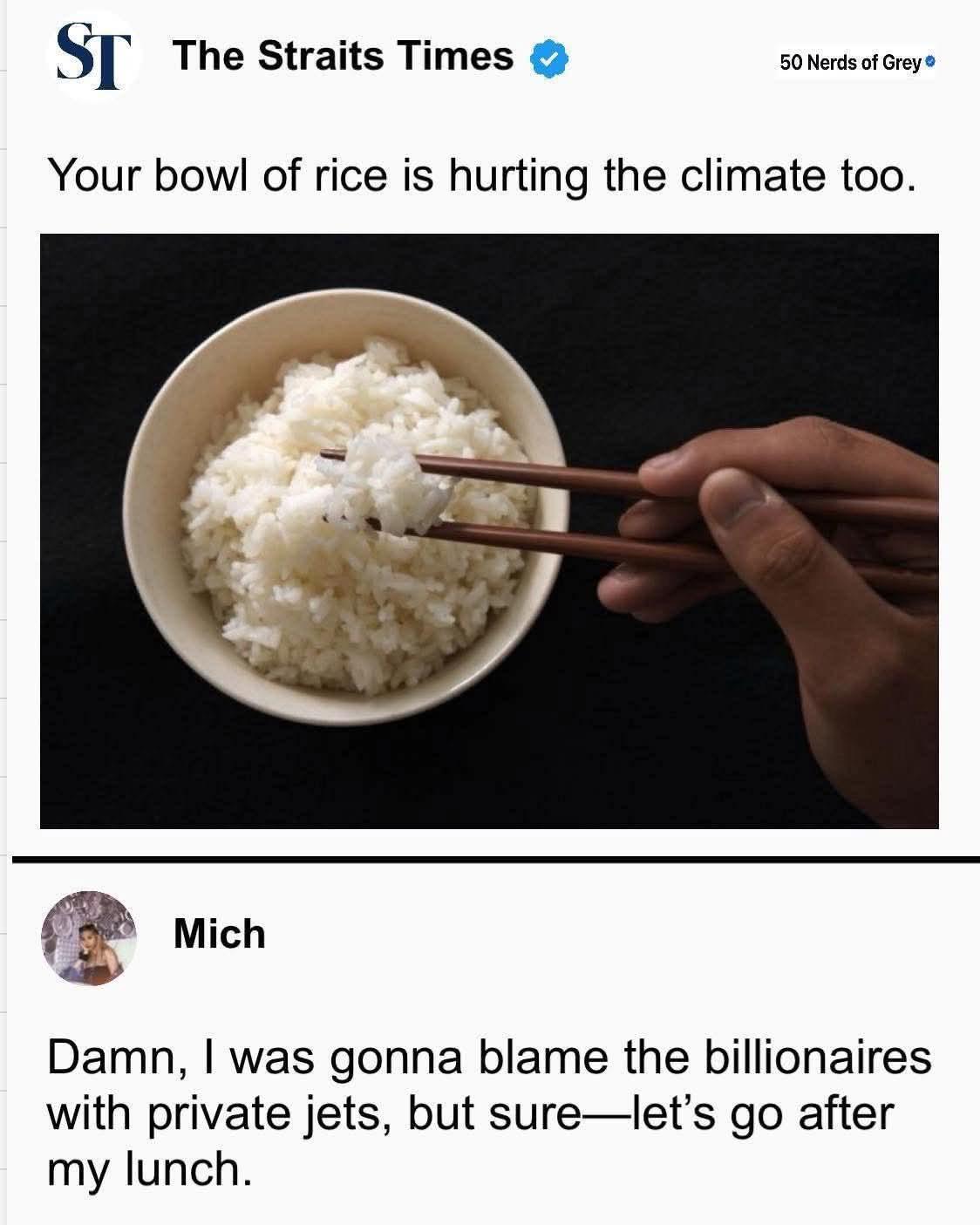
Rice doesn’t have to be grown in flooded paddies, that’s just an ancient, chemical-free way to prevent weeds from growing. You could still grow rice the same way you’d grow wheat or corn and it can actually be less work to do it that way. It would, of course, require more reliance on herbicides for weed control, though, which is its own can of worms. The water also allows other means of food production to happen alongside the rice growing, such as raising fish or ducks. I wonder if symbiotic dual-use of the water would offset, or even directly reduce, the relatively higher methane levels that might be generated within the water. Bonus points if you hook up a turbine to the outflow when you go to drain your paddies.
These are definitely interesting perspectives. However, even though rice can be produced with much fewer emissions, today the emissions are high. This is why @Barley_Man@sopuli.xyz is perfectly right in saying that rice is hurting the climate.
(Dry farming accounted for just 4% of global rice production in 2022 [1].)
It’s impossible to ‘hurt the climate’ using non-ancient non-sequestered sources.