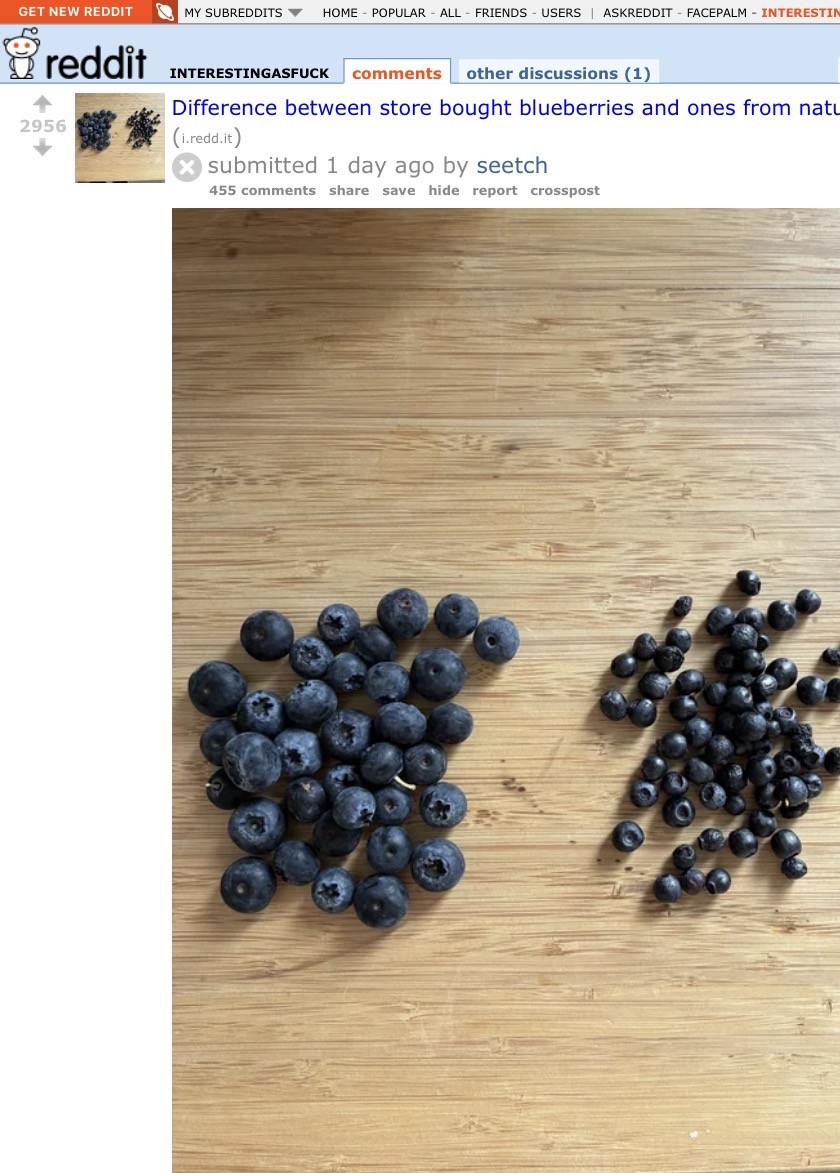
They are different species after all, another difference could be seen slicing them and putting them side by side, the pulp should have a different color too
Or storebought blueberries and wild bilberries?
I’m not a native speaker of English, and I’ve only recently learnt that the ‘blueberries’ I grew up foraging from the woods are in fact bilberries. Which is kind of interesting because although most people will call them blueberries, we have a regional name for them, ‘brimbelles’, that’s kind of similar to bilberries when you squint your eyes.
It’s the same in Finland, I was raised thinking that I was eating blueberries when they were, in fact, bilberries.
You did eat blueberries. In Scandinavian languages bilberries are called blueberries (blåbær, blåbär), because what Americans calls blueberries didn’t exist there (the American sort was only introduced to Europe in the 1930s).
English isn’t alone in deciding what is a blueberry and what isn’t.
So really we should be calling those insipid, watery grape-sized ‘blueberries’ impostors. It ain’t a blueberry if it doesn’t stain your mouth purple!
The wild North American blueberries (there are multiple species) are also small and flavorful. The giant, watery ones are a bred variety that you won’t find in nature
I stand corrected.
We’re eating mustikka over here, which translates to bilberry in english. The “blueberries” are pensasmustikka in finnish.
Huh, TIL!
Anyone who spends time in nature will tell you about varietals. You are being deliberately aggravating against readily accessible fruit. It’s still fruit. It’s still healthy. It’s strange you would gatekeep berries.
chill bro the post made no statement about which is better. you instantly value judged a picture of two heaps of berries
No! They are gatekeeping our blueberries and you are gaslighting us!
You are being deliberately aggravating against readily accessible fruit
🤺
High bush vs low bush blueberries. They’re so different they may as well be a separate berry.
Do you call them that because the bushes themselves look different?
The wild sort grow in low shrubs up to maybe mid-shin whereas the one you bu from the garden centre is more of a bush
Yeah, they are like chest to face high, depending on your height.
Thanks! TIL
There’s also rabbiteye, which are similar to high bush but have lower cool hour requirements. Maybe it’s a subtype of high bush, but horticulturists around my area note a distinct difference in them.
*not shown - flavor is inverse to size.
Not exactly true. Too small they’re bitter, too big they’re bland. There’s a sweet spot in the middle.
There’s a sweet spot in the middle.
The pulp, yes
You can get both of these at my grocery store. Right next to each other. Sometimes the same brand, sometimes different. I grew up eating off the tree/large bush and found all different sizes on the same tree. Main difference is the flavor.
Main difference is the flavor.
Can you elaborate?
One tastes like blueberry, unlike the other which tastes like blueberry.
Odds are the ones on the left are Driscoll’s genetic berries. Neat youtube documentary on Driscoll’s monopoly on the berry market.
I just watched this the other day, good vid
I’ll second this!
Great video, worth a watch.
I had to explain this to a person I care much about once… Some balls are big and some are small, I just happen to have one of each. They’re both delicious.
Those are probably only different species, maturation levels or even size of the same species, cut the crap
Also, stop reposting :3
Bluebarries in many store-bought “blueberry” muffins: blue coloring with bits of minced grape skins for convincing texture.
these are different species? Here we call the left ones American blue berries and the right ones would be our native ones, that are blue/purble inside; Americans would however call them bilberries.
Damn. Nature doesn’t stand a chance!
There’s no difference in health value per berry. Smaller berries gives you more bang for your buck.
The most interesting part is the wild ones are even better for you than the store bought. Much more concentrated nutrients in all wild foods.