

In a closed system, deterministic dynamics perfectly retains information about the state of the atmosphere, assumed to be perfectly known at the initial time, suggesting infinite predictability. In reality, incoming solar radiation, however, injects variance with unknown quantum characteristics that act as noise, destroying information first on the smallest scales. Through the upscale propagation of energy, noise eventually affects all parts of the system. When the total energy in the atmosphere is entirely replaced, any predictability as defined above is completely exhausted.
Using the relatively well-measured quantities of total energy in the atmosphere and the incoming and outgoing radiation fluxes at its upper boundary, we estimate that the range of skillful forecasts could potentially be extended by 57 days at the most. Interestingly, such an extension would correspond with the addition of a similarly long, 57-day forecast period characterized by skill just below that observable in today’s forecasts. The full range of predictability then equals the sum of the two 57-day extensions and today’s skillful range of 14 days, estimated to be 129 (±7) days. By how much, and when this potential may be realized in practice, will be determined by future improvements in forecast technology.
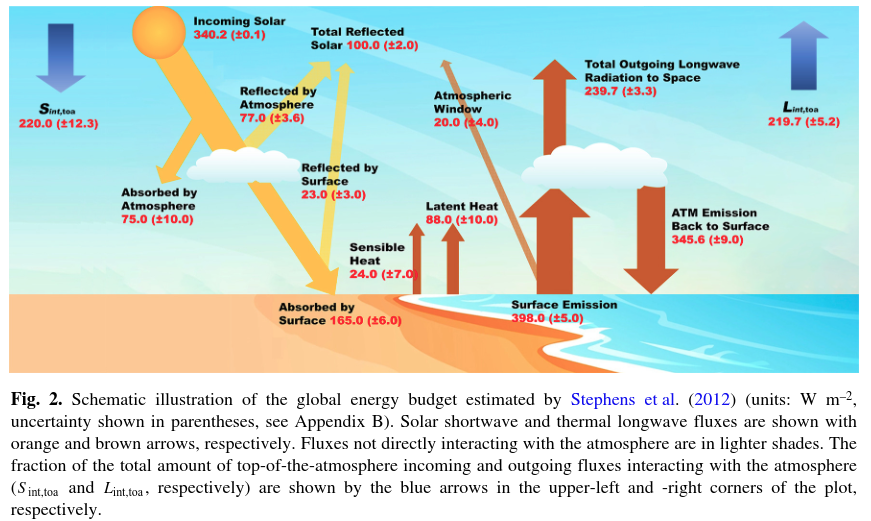
Fig. 2. Schematic illustration of the global energy budget estimated by Stephens et al. (2012) (units: W m–2, uncertainty shown in parentheses, see Appendix B). Solar shortwave and thermal longwave fluxes are shown with orange and brown arrows, respectively. Fluxes not directly interacting with the atmosphere are in lighter shades. The fraction of the total amount of top-of-the-atmosphere incoming and outgoing fluxes interacting with the atmosphere( and , respectively) are shown by the blue arrows in the upper-left and -right corners of the plot, respectively.