

cross-posted from: https://hexbear.net/post/8372210
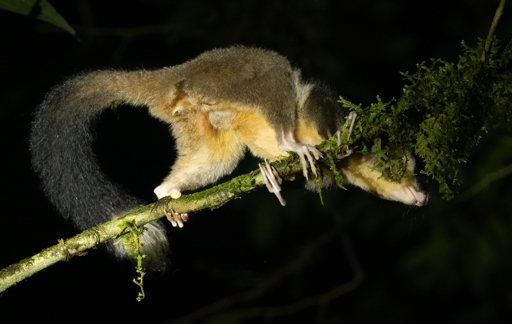
Banner image: A pygmy long-fingered possum (Dactylonax kambuayai), photographed in 2023. Image courtesy of Jon Hall/mammalwatching.com.
‘Rediscovered’ species in Papua spotlight importance of Indigenous knowledge
- Two species of marsupial thought by scientists to be extinct for thousands of years still live in the forests of Indonesian Papua on the island of New Guinea, according to recently published research.
- One of the animals, the ring-tailed glider, is sacred to the Tambrauw people, and it’s part of a newly proposed genus, Tous, borrowing the Tambrauw name for the glider.
- The other animal, a pygmy long-fingered possum, was discovered during a mammal-watching trip on the Bird’s Head Peninsula.
- The research involved substantial collaborations with local communities and Indigenous elders.
It started with a set of photographs, taken of an animal captured in 2015 on the Bird’s Head Peninsula in Indonesian Papua, the western half of the island of New Guinea. The smallish animal with “large hands” looked a bit like a slow loris, a small primate that doesn’t live on the island, or perhaps a cuscus, which, like this specimen, is also a marsupial. Further inspection of the photos, however, suggested it might be something else altogether, a species long thought lost to extinction — by scientists, anyway.
Interviews in local communities provided a breadcrumb trail suggesting that a forest-dwelling glider, known — again, to science — only from millennia-old fragments of teeth and bone, might yet live in the forests of Indonesian Papua.
Several years later, Rika Korain was approached by her longtime friend and colleague, Australian mammalogist Tim Flannery, who asked if she might help him get a bead on whether the animal still existed.
Korain, a human rights lawyer and Indigenous Maybrat woman, immediately thought of the elders from the Tambrauw people, a group that lives close to the Maybrat and with whom they share traditions in common.
“I’m from the Bird’s Head area,” she says. “I told [Flannery], let’s find out from my clan, from my people’s side. Let’s try to talk with the elders or especially the hunters who always go to the jungle to find out whether they see this particular animal.”
So in 2023, she and Flannery spoke with two Tambrauw elders, Barnabas Baru and Carlos Yesnat. They confirmed that they know the glider from nearby forests and that it had once been more widespread before forests closer to the town of Sorong had been logged.
The photos from 2015, along with the elders’ testimony, proved that this animal, the ring-tailed glider, still exists in forests on the Bird’s Head Peninsula, despite scientists having concluded that it had gone extinct some 6,000 years ago.
Flannery, Korain and their colleagues recently reported their findings in the journal Records of the Australian Museum. The team calls the glider Tous ayamaruensis, borrowing the Maybrat and Tambrauw name. It also differs enough from related species to justify designating Tous as a new genus among marsupials that includes several other gliding species identified from fossils.
In the same issue of the journal, Flannery was also the lead author of a report on the existence of another species scientists thought was extinct: the pygmy long-fingered possum (Dactylonax kambuayai).
Scientists thought the pygmy long-fingered possum had gone extinct 6,000 years ago, until a group of mammal watchers photographed one in 2023. Image courtesy of Jon Hall/mammalwatching.com.
“It’s been a massive joint effort,” Flannery says. He and his co-authors on the research acknowledge “the fundamentally important approach of integrating both indigenous ways of knowing and understanding the world, and scientific approaches” in the paper describing the ring-tailed glider. For Flannery, that lesson comes from more than 45 years working on mammal zoology in New Guinea.
“My career really is a result of the cumulative knowledge that’s been passed on to me by tribal elders all across the island,” he says. “They really are my great professors. They’re the people that I learn from.”
Decades of listening, building trust and working with local communities and Indigenous groups have helped Flannery shine a light on the wondrous diversity of mammals living in what one scientist describes as a “natural laboratory of diversification.” But New Guinea and the people who call it home also face the threats of the modern world from development, agriculture and logging. Flannery says he hopes a similar spirit of collaboration will ensure these species persist.
A map showing where the ring-tailed glider is found. Image courtesy of Flannery et al., 2026.
‘Something sacred’
In the elders’ descriptions, Korain noticed something different in the way they talked about the animal they called tous wan. Often, her questions were met with a deferential way of speaking in a “low tone.” The women typically wouldn’t use its name at all, instead referring to it as “that animal.”
That deference tipped off Korain that “it is probably something that’s sacred in our culture,” she tells Mongabay. Soon, she was mining the recesses of her memory, thinking back to stories her father told her of initiation rites that would take boys into the forest for a year or more for “traditional education” — in hunting, medicinal plants and sacred rituals, Korain says.
In their interviews with Baru and Yesnat, she and Flannery uncovered not just the animal’s existence but its role in Tambrauw cosmology.
“It really seems to be at the center of knowledge in a complex series of initiations that bring cultural prestige with them,” says Flannery, a distinguished visiting fellow at the Australian Museum. That made it challenging to discern whether it still existed because, he explains, “Initially, we didn’t understand that it was such a sensitive animal, such an important animal culturally.”
As Korain and Flannery spent time with Baru and Yesnat, the elders began to open up about the glider, its behavior and where to find it, and why it was sacred to them.
What the women referred to as “that animal” was a gliding possum, with a curled, prehensile tail and the bulging eyes that befit its nocturnal habits. (The team is deliberately vague in describing the precise locations of these sightings, to protect the species from wildlife trafficking.)
An artist’s rendering of the pygmy long-fingered possum (Dactylonax kambuayai). Image by Peter Schouten courtesy of Flannery et al., 2026.
New Guinea’s varied topography and terrain have led to bursts of differentiation among species on the island. Robin Beck, a professor of biology at the U.K.’s University of Salford, who wasn’t involved in this research, calls New Guinea an “engine of speciation,” owing to its unique geological history and diverse habitats. That makes it a fascinating place for scientists to study.
What’s more, the fossil record shows that the ancestors of the two species have ancient genealogical ties to Australia. Geologically, the Bird’s Head is part of the Australian continent and is “very different from the rest of New Guinea,” Flannery says.
The peninsula is also a place where unusual traits evolve, at times converging with those of other species from distant parts of the globe — like the pygmy long-fingered possum, for example. They have “specialized ear regions” that allow them to zero in on where beetle larvae are tucked away in rotting wood, Flannery says, along with robust incisors to tear away wood and get at their quarry. Most eye-catching is the possum’s wildly extended fourth digit and curved claw, a remarkable adaptation used “as a sort of fishing rod … to go in and hook the grub and pull it out of the burrow.” Flannery thinks of long-fingered possum as “marsupial woodpeckers, in a way.”
“It’s endlessly fascinating,” he says of the decades he’s spent studying New Guinea’s animals. “Sometimes you just do sit back and think, ‘Wow, how likely is it that anything like this would ever evolve?’”
Beck calls the Flannery-led research “really fantastic” and notes the cooperation necessary to bring these findings to the attention of the scientific world.
“It’s wonderful that local people have been involved in the discovery,” he tells Mongabay. For scientists, that collaboration is critical to finding the animals, but also to understanding how they live and behave.
“How do they find out about the biology of these organisms? Yes, they go out and observe them,” Beck says. “But at least as valuable is to talk to the local people and say, ‘Well, tell me about this animal.’
“They’re essential, really,” he adds.
For Flannery and his team, the intimate knowledge that the Tambrauw elders had of the ring-tailed glider opened a window into their habits. For instance, a mated pair of gliders has a single baby each year, Flannery says. And it lives in tall trees and will trim the leaves that are in its glide path from tree to tree, which the Tambrauw see as a type of gardening.
“In a sense, this animal is the ideal for humans. It’s monogamous, has one wife, has a small family that it looks after, and it looks after its environment,” Flannery says. “And I think that is the central story for young men during initiation.”
The ring-tailed glider (Tous ayamaruensis) holds a sacred place in Tambrauw culture. Image courtesy of Dewa/FFI.
A question of perspective
In 2023, University of Oxford biologist James Kempton led an expedition to the Cyclops Mountains in Indonesian Papua. The team revealed with camera-trap photographs that the egg-laying Attenborough’s echidna (Zaglossus attenboroughi), a species that scientists believed had gone extinct since it was last seen in 1961, still plied the mountains’ forests.
These findings, of the echidna, as well as those around the ring-tailed glider and the pygmy long-fingered-possum, are often framed as “rediscoveries” of “lost” or “Lazarus” species. But that doesn’t tell the full story, Kempton says.
“When we use terms like ‘Lazarus species’ and ‘rediscoveries’ and ‘lost species,’ that is only within the perspective of a subset of people” — namely, the Western scientists who didn’t know these species still existed, he says.
“They are not actually ‘rediscoveries,’” Kempton adds. “They’re just reports of knowledge that Indigenous communities have had for a long time.”
For the Cyclops expedition, he worked with Yayasan Pelayanan Papua Nenda (YAPPENDA), an Indonesian NGO that he credits with helping to find “common ground” between scientists and communities that made the echidna expedition a success.
Without that trust, such success can be elusive, says Malcolm Kobak, co-founder of YAPPENDA. He recounts a “humbling” story about his team’s role in searching for Attenborough’s echidna in 2023: An elder from the community of Yongsu Sapari, who are traditional owners of part of the Cyclops Mountains, said they had “misled” prior expeditions because they didn’t trust them. The echidna is sacred to the people of Yongsu Sapari, just as the ring-tailed glider is for the Tambrauw. YAPPENDA, by contrast, had taken the time to build relationships with the community’s people, obtain their consent and include them in the expedition, the elder said, which demonstrated the organization’s care for his people.
A research camp on the Bird’s Head Peninsula in Indonesian Papua. Image courtesy of Shane McEvey.
Those community members played invaluable roles that contributed to finding the echidna, Kobak says.
“All the Western scientists commented [that] these guys would be the best field biologists in the world,” he adds. “They’re just unbelievable in the forest,” whether it was finding or spotting animals, or shimmying up a tree.
Kempton says he sees a future in which Indigenous-led fieldwork is the norm.
“In the case of Tim Flannery and his co-authors, that is exactly the kind of approach that they take,” says Kempton, who wasn’t involved in the work on the Bird’s Head Peninsula. “Tim has always been a very responsible individual on this front and has always cultivated very strong and trusting relationships with Indigenous people.”
The work continues for Flannery. He and his teammates aim to search for more species that are unknown or poorly understood by scientists, and to better understand the habits of the possum and the glider, to be sure. But they’re also focused on working with scientists, Indigenous peoples and the Indonesian government to keep these places intact.
The Bird’s Head’s relatively extensive road network, its deepwater port and its accessibility to the rest of Indonesia mean that the forests there are vulnerable to logging — the logging that the Tambrauw say caused the disappearance of the ring-tailed glider in parts of its former range.
Elsewhere on the peninsula, plantation companies have eyed the primary lowland forests of the Klasow Valley as sites for oil palm, says Isai Onesimus Paa, a local guide from the village of Klalik. It was in the nearby lowland forests that co-author Carlos Bocos snapped the first photos of the long-fingered possum during a 2023 mammal-watching tour led by Bocos and Jon Hall.
Even before finding the possum, ecotourism has brought economic prosperity to the village, Paa tells Mongabay by WhatsApp message. The benefits that come from visiting tourists have provided more options and new opportunities for young people, who are now more likely to stay in Klalik, he adds. And now those visitors can see the long-fingered possum along with echidna, cuscus and tree kangaroo.
Still, communities in the Klasow Valley face an uncertain future, Paa says, if their customary land rights aren’t respected.
“Besides legal enforcement, indigenous communities must unite to defend their territories,” he writes.
A young ring-tailed glider (Tous ayamaruensis). Image courtesy of Arman Muharmansyah.
The next steps for Flannery involve supporting those customary land rights in ways that complement broad-scale protections like national parks, he says.
“We believe that unless you involve the local, traditional owners of the forests, you don’t have a long-term future in terms of conservation,” Flannery adds.
Rika Korain, who’s spent a career focused on environmental protection and human rights, sees the benefit of incorporating traditional values into conservation. She notes that for the Tambrauw, hunting the ring-tailed glider is taboo because the animal represents a connection to their ancestors.
Finding ways to uphold those values as part of the approach is a way to get people “excited about conservation,” YAPPENDA’s Malcolm Kobak says. “So why not design it as your strategy?”
What’s critical, he adds, is the involvement of communities from the beginning and throughout the process, just as it is for the success of research expeditions.
“You can’t protect the forest without the people,” Kobak says, “and you can’t protect the people without the space that they live in.”
Scientists believe that the forests of New Guinea likely hold species of mammal that are new — or have been ‘lost’ — to scientists. Image courtesy of Shane McEvey.


